Bright Works Press

Home of Oregon mystery writer Rod Collins

  • Fiction Books
    • Bitter’s Run
    • Abiqua
    • Spider Silk
    • Stone Fly
    • Bloodstone
    • Mariah’s Song
    • Not Before Midnight
    • Snapped
  • Non-fiction
    • What Do I Do When I Get There? A New Manager’s Guidebook
    • Rogue River Diaries
  • About Rod
    • Contact Rod
  • Blog
  • Contact Rod
  • Fiction Books
    • Bitter’s Run
    • Abiqua
    • Spider Silk
    • Stone Fly
    • Bloodstone
    • Mariah’s Song
    • Not Before Midnight
    • Snapped
  • Non-fiction
    • What Do I Do When I Get There? A New Manager’s Guidebook
    • Rogue River Diaries
  • About Rod
    • Contact Rod
  • Blog
  • Contact Rod
You are here: Home / Archives for History of a Life

Smoked In

Leave a Comment

I lived most of my first seventy-eight years within spitting distance of Oregon’s national forests, the timberlands of the Bureau of Land Management and one National Grassland. In those years, Oregon experienced a few large forest fires and grass fires. But while I breathed smoke for a week or two in prior decades, it wasn’t until the summer of 2019 I spent nearly the whole summer smoked in. Even the Oregon coast was smoked in from time to time.

This summer (2023) is no different. I think I know why. During the Obama administration the Bureau of Land Management and the USDA Forest Service agencies were told to use regular appropriations to pay for fighting wildfires, something unheard of from any previous administration…be it a Democrat or Republican administration. There were no other funds for firefighting. As a consequence, the annual work to reduce hazardous fuels (called brush disposal) and thinning of thick stands of trees (called dog hair thickets by us old timers) stopped. For eight full years.

Mother nature is relentless. Every millisecond of every day, plants grow. No stopping them without killing the plants. And even then a new seed will germinate. The astounding recovery of the plant life in the Yellowstone National Park following the last devastating fire is proof positive. The recovery of plant life following the Mount Saint Helens volcanic eruption is another.

Looking back to 2019 and the fires in between, fires like the Almeda fire that burned whole towns in Oregon, the cause was twofold: Heavy increases in highly flammable fuels and a federal administration that refused to fund proper management of public lands.

I don’t know what kind of smoke those public officials are breathing, but the rest of us are breathing wood and grass smoke started by the ineptitude of our politicians. I have to wonder if they even care.

Rod

8-30-2023


Filed Under: History of a Life, Social Commentary

Over Organized

Leave a Comment

Our local TV station runs a puff piece or two every evening of the year, pleasant stories about riverside cleanup, trail maintenance, new brew pubs, rallies, fund raisers for the homeless, fund raisers for our hungry children, all good effort and not to be despised. We are a generous people, after all.

The focus is almost always on local groups of good hearted people working to correct what appears to be the failure of our culture and of our economy to help people. (It is notable the stories are about effort, but not much about outcomes.)

And the list of help organizations simply amazes me. It seems nothing gets done unless it gets done by a group, and it seems if you want to get something done, first you have to join one, or organize a group yourself.

However, I have a nagging suspicion the emphasis on “group” is slowly eroding the old American value of the stand-alone, rugged individual. Without that standard, I’m seeing a growing number of young adults who can’t or don’t want to stand on their own. They mouth the words “life-work balance,” and then go crying to their parents for money to pay the rent, while employers are begging for people who want to work. I wonder if the term self-reliance is simply an anachronism of the past, dead in this age of overly organized life.


Rod


Filed Under: History of a Life

A Fine Kettle of Fish

Leave a Comment

We didn’t just fish the Rogue River when I was growing up, although it was  the most frequently enjoyed. Probably because it was great fishing at that time, but also because our two acres ended at the river bank. It was an easy walk from the back porch, fly rod in hand, an old fashion wicker creel over one shoulder, down across the pasture, through the willow and alder trees, and to the upper reach of about four-hundred yards of ice cold riffles. In ten years, I don’t remember anyone other than me and Dad ever fishing that stretch. I did see one drift boat one time one summer out of ten summers. But that was all. We didn’t own the riverbank in below the house, but it served as our private stretch of river for most of ten years. (I’d love to find a place like that again.)

Dad wore hip boots, top drawer back then, but he wouldn’t let me wear any. He was afraid I’d fall, get the boots full of water and then he’d have to watch the strong river current wash me away. I’m not sure I ever heard of any local person dying that way, but my dad was a great student of land mines, the kind life can bring the unwary.

No, no boots, but it didn’t keep me out of the water. I’d wear my tennis shoes, wade out until the current was almost strong enough to sweep me off my feet, and then go to fishing. It was cold, but a few minutes in the water would numb my legs and the pain would go away.

I remember once when a big fish took my fly and raced downstream, pole bent, line stretched, reel singing, and I took a step downstream into a small hole in the gravel. That time I just swam…one handed…fishing pole in the other hand…toward the bank until I could get my feet under me. Dad always said he could get another fly rod, but he couldn’t get another son. So if the choice was hang on to the pole or drown, he rather I just let go of the pole.

I didn’t let go that time…and I landed a nice fat eighteen inch Rainbow trout. In looking back, I’m pretty sure it was one of the summer half pounders that filled the river in July way back then. They call them steelhead now, so I reckon I’ve been catching steelhead since I was about nine years old.

One week-end Dad decided on a change. He said we ought to try Hyatt Lake and fish for the large mouth bass that lived there. It was a fair sized meadow at one time…maybe four miles long, and when the dam was finished and when the Corps of Engineers began filling the pool, no one bothered to cut the trees out of the margins of the meadow. What was left was a ghost forest of dead, white snags sticking out of the water along the edge of the reservoir, and big old buckskin logs floating in amongst the snags. Ugly as sin, but wonderful fishing.

We loaded Dad’s little WWII quarter ton jeep with a big tarp, our bedrolls, the old grub box (which I still have), put our fishing poles and tackles boxes in the boat, hitched the old heavy McKenzie River boat behind the jeep, and headed for the lake…about fifteen miles east of Ashland, Oregon on the Greensprings road to Klamath Falls.

There was only one other boat on the lake when we got there, so we had it pretty much to ourselves. We set up camp, and then Dad backed the drift boat into the lake and we went to fishing in amongst the snags and logs. I think I was about ten years old, and I loved it. There we were, just me and my dad.

In the last hour before sunset the lake was mirror calm and we got into the bass. We’d cast a redheaded Heddon plug in against a log, let it sit a few seconds and then give it a crank, let it pop back to the surface, and repeat. About every third cast the water would boil and we’d set the hook on a nice bass. We fished until the sun set and Dad decided we might have trouble finding camp in the dark. It was hard enough to see camp in full daylight.

Dad cranked up our old Evinrude five-horse outboard, I pulled the stringer of live fish into the boat, and we threaded our way through the snags back to camp. Dad said to tie the stringer off and leave the fish in the water.  Said we’d tend to them in the morning. Being a kid, I had to count the bass: seventeen bass with a couple running about five pounds each, and a couple more running about four pounds. I had caught about half of them, so I was pretty puffed up.

We got a fire going and Dad fixed a near perfect supper…0ne I copy now and again in my old age…home raised beef steaks, bread and butter, and fresh milk from our milk cow Queeny. If you have never had that kind of supper, you don’t know what you are missing. Maybe the open campfire makes a difference, but whatever it is, it’s a prime supper.

We laid our bedrolls on the front half of the big canvas tarp and pulled the other half up over our heads. Snug it was.

Come morning I trotted down to the lake to clean the fish. I couldn’t believe it. The fish were gone. I was sure I had tied the string up good and tight. I thought maybe a critter had dislodged the chain, but I wasn’t sure that made sense, but I’m sure I didn’t want to think I had messed up.

I walked back to the breakfast fire and told Dad. He laughed, said to get a long pole and work the boat out among the snags. The fish couldn’t have gone far.

I spent a frustrated half hour, and then there they were, kegged up against a little upright snag that stuck up out of the water. Looked like half the bass wanted to go right and the other half pulled to the  left. (You know, you just can’t get a stringer of fish to cooperate. Good thing.)

We cleaned the bass, broke camp and headed home before they spoiled. When we pulled into the yard, I rushed into to the house with our bucket of bass to show Mother. She said, “That’s a fine kettle of fish.”

Rod

I don’t know if this qualifies as a blog. Maybe not, but I’m running out of old timers to feed my stories to, and my grandkids are busy with their own lives, so I’ll just tell my stories this way.  Thanks.

Filed Under: History of a Life

Places Of The Heart

Leave a Comment

I find it hard to verbalize the reason some places just reach out and grab my soul, places which make me feel more connected to life than anywhere else. And occasionally I wonder why some places warm my heart while others, including some spectacular places like the Grand Canyon, seem to be merely something to look at like a picture of any tourist attraction. Nice, but cold and a bit out of reach. I don’t mind being able to say, “I’ve been to the Grand Canyon,” but I know I wouldn’t drive fifty miles out of my way to see it again. I hope that doesn’t make me sound narrow minded, but there just wasn’t any spark of life there for me.

At times there is an aesthetic lure to a place which doesn’t need much explanation. Delintment Lake high in the Ochoco Mountains some forty-five miles West of Burns/Hines, Oregon is one of those. I have no trouble remembering my first look at the little lake as I rounded the corner of the road. There it was, a pristine blue jewel bordered by tall yellow pine trees. A bit small at sixty acres, but beautiful for all of that.

I remember my first lunch there in the shade of the pine trees with an old Forest Service friend. It was quiet. Just one party of campers in the camp ground. We sat at an empty picnic table and watch bright silver trout feeding on the surface of the lake. Golden mantle ground squirrels begged for food, and a camp robber stole chunks of the sandwich bread I tossed to the squirrels. I wanted to stay and just soak it in.

My family and I followed that urge with dozens of camp outs there, and loved every minute of it. Perched as it was on the ridge top, Delintment Lake was harried by summer snow, hail and heavy rains, storms which tried to ruin some of our trips from time to time. But a camp out at Delintment was always worth it, hard weather not withstanding.

As I approach old age, I’m reminded life seems the sweetest when I revisit those places which feed my soul.

Rod

p.s. Stay tuned for more Places of the Heart

Filed Under: History of a Life

Finding the Ancients

8 Comments

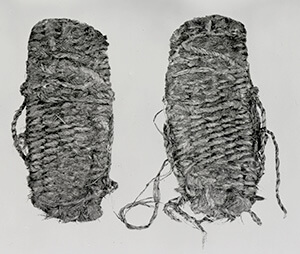
As I look back in time, I’ve decided the germination of my interest in Oregon’s High Desert began in 1952. Our teacher, Mrs. Ann Briggs brought to school a gnarled and twisted sagebrush sandal on a cookie tray, a fragile human artifact obviously made for a human foot. “No touching,” was her order to our fifth grade class as she carried the tray slowly by each of our desks.

And then she told a story of her cowboy brother finding the sandal in a cave in Fort Rock. Her brother never gets a mention in the recorded history of the Fort Rock Cave. Only the archaeologists who claim the find are mentioned, but I believe Mrs. Briggs nonetheless. After all, she had the sandals and the archaeologists didn’t…yet.

Fort Rock Sandals
Sandals from the Fort Rock cave. Courtesy of Oregon Historical Society.

I never saw sagebrush sandals again until I walked into The Indian Village restaurant in Lakeview, Oregon in the summer of 1964, the first season of my firefighting days with the US Forest Service. There, in hermetically sealed cases, for all the world to see were sagebrush sandals made by the early people. A little brass sign on the case gave the estimated date of their creation as about 8,000 year ago. I don’t know to this day if those hermetically sealed sandals were the same ones I had seen as a boy, but they could have been. They looked the same, all gnarled and twisted, and they looked somewhat serviceable.

On the walls of the restaurant were dozens of big, glass covered picture frames protecting hundreds of beautifully crafted Indian arrowheads, spear points, scrapers, and what I guess to be obsidian knives. I was hooked. Instead of an empty desert, I could envision a land full of people busy living their lives as hunter gatherers.

And so in my spare time I went in search of the ancients.  Over the years, I found rock blinds, ancient petroglyphs, rock art, a cave used by ancient people, and rattlesnakes. On one memorable occasion, my wife and I found a really comfortable rock surrounded by obsidian chips. I tried this ancient seat, and it wasn’t difficult to see what the artisan saw, sitting there, turning chunks of obsidian into tools, watching flocks of geese and ducks sailing in to feed on the salt grass at the north end of Abert Lake. Close by, a smooth, deep bowl in a flat six foot slab of rock bore testament to years of pounding and grinding wild grains to separate the husk from the meat. (My archaeology friend Hugh Bunten told me of archaeological evidence supporting the notion that about twenty wild grains had been part of the early High Desert Indian diet, but most of the wild grains were extinct now.)

I came tantalizingly close to parting the curtain of time and actually being there, in that place with that ancient person, the watcher, the obsidian napper. The artifacts that once adorned the walls of the Indian Village are gone now, housed in a museum most likely, but the rock at the north end of Abert Lake is still there. Maybe I’ll try that rock again one day, and maybe this time I’ll step back into the world of the Ancients.

Rod

Filed Under: History of a Life

Copyright © 2026 · Author Pro Theme On Genesis Framework · WordPress · Log in